Material Guide · 7 min read
Quartzite vs. Granite: Is the Premium Worth It for Your Charlotte Kitchen?
February 20, 2026 · The Granite House Team
February 20, 2026 · The Granite House Team
Quartzite is one of the most misunderstood countertop materials on the market. Many Charlotte homeowners confuse it with quartz (an engineered surface) — but quartzite is a completely different material. It's a natural stone, formed when sandstone is subjected to extreme heat and pressure deep within the earth. The result is one of the hardest, most beautiful countertop surfaces available — with flowing marble-like veining and serious durability. If you're curious how granite compares to engineered quartz, we break that down separately.
So how does quartzite compare to granite, the longtime king of natural stone countertops? And is the higher price tag justified? Here's what Charlotte homeowners need to know before signing off on a slab.
Granite is an igneous rock — it formed from cooled magma, which gives it a speckled, granular appearance with visible mineral crystals. Quartzite is a metamorphic rock — it started as sandstone and was transformed under extreme heat and pressure. That metamorphic process fused the quartz grains into an incredibly dense, hard material with distinctive flowing veins. Where granite looks earthy and speckled, quartzite looks elegant and directional — closer to marble than to granite in appearance.
This distinction matters when you're standing in a slab yard trying to make a decision. Granite gives you depth and movement through mineral flecks — you'll see mica, feldspar, and quartz crystals catching light at different angles. Quartzite gives you sweeping veins that run the length of the slab, sometimes with translucent areas that almost glow when backlit. They're both natural stone, but the visual effect is completely different.
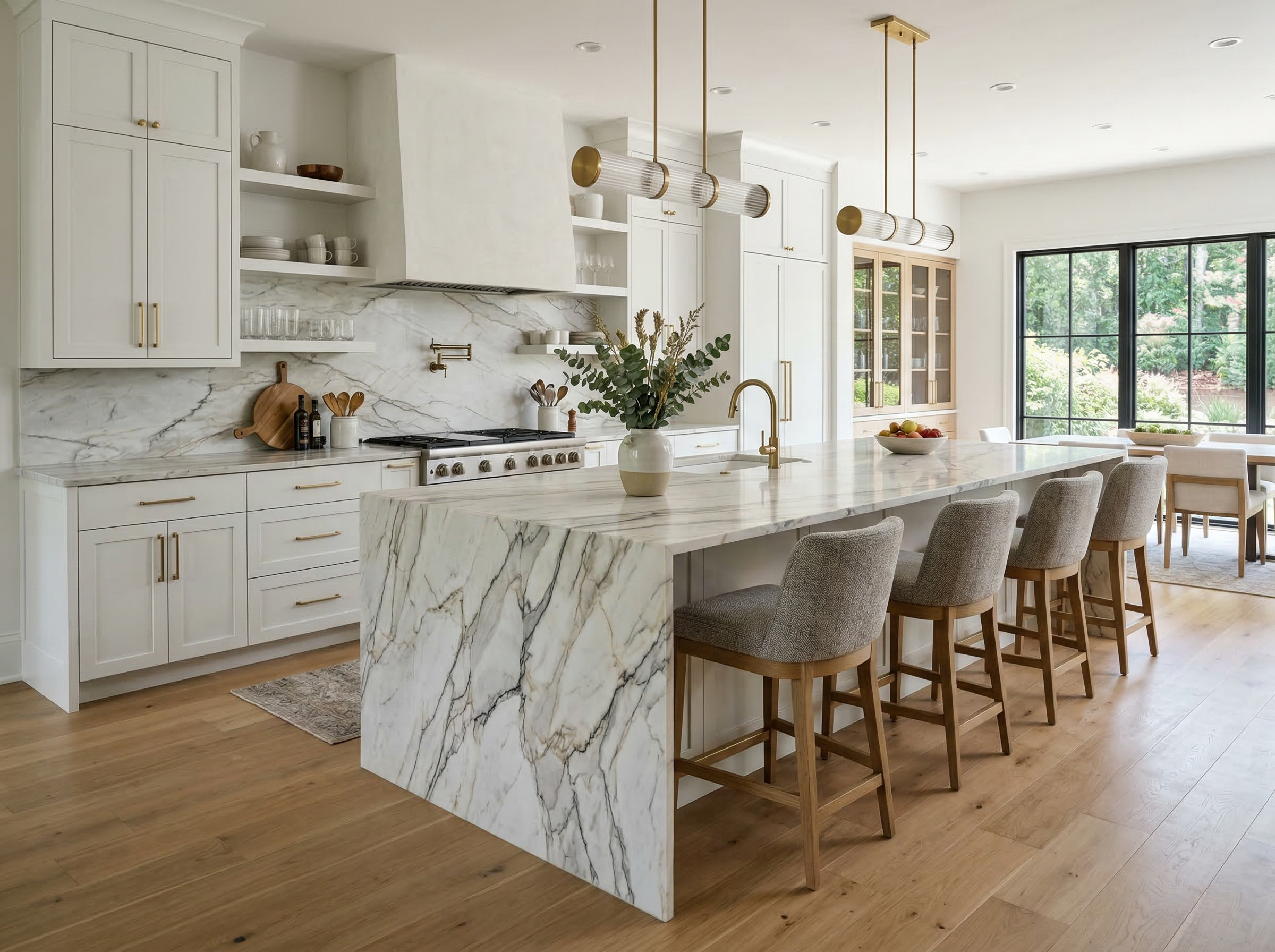
Quartzite rates a 7 on the Mohs hardness scale, making it harder than granite (6 to 6.5). In practical terms, quartzite is more scratch-resistant and more resistant to chipping from daily kitchen use. Both materials handle heat beautifully — you can set a hot pan on either without worry. But quartzite's superior hardness means it's less likely to show wear over years of heavy use. If longevity is your top priority, quartzite has the edge.
That said, granite is no pushover. We've installed granite kitchens in Charlotte homes 15 years ago that still look fantastic. Granite handles knives, hot pots, and daily abuse without complaint. The durability gap between the two is real but not dramatic — both will outlast your kitchen cabinets, your appliances, and probably your mortgage.
Both quartzite and granite are natural, porous stones that benefit from periodic sealing. Granite countertops typically need resealing every 6 to 12 months — it's a 10-minute job with a spray-on sealer you can pick up at any hardware store. Quartzite's superior density means it generally needs sealing less often — every 1 to 2 years. Both clean easily with mild soap and water. Neither material requires special cleaning products.
One thing to keep in mind: not all quartzite slabs seal the same way. Softer quartzites (some of what's sold as "quartzite" is actually dolomite or marble mislabeled at the quarry) can be more porous and need more frequent sealing. This is why buying from a fabricator who knows the material matters — we test absorption on every slab before we cut it.
Quartzite is the premium option. In Charlotte, granite runs $35 to $55 per square foot installed, while quartzite ranges from $55 to $85 per square foot. The higher cost reflects quartzite's superior hardness — which makes fabrication more time-consuming and requires specialized diamond tooling — as well as growing demand from homeowners and designers who want the marble look without the marble headaches. Some exotic quartzite slabs with rare veining can push past $100 per square foot. For a full breakdown of what every material costs in the Charlotte market, check our 2026 countertop cost guide.
Is the premium justified? For many homeowners, yes. If you're building a high-end kitchen or renovating a home in Myers Park, SouthPark, or Ballantyne where resale matters, quartzite signals luxury in a way that few other surfaces can. It gives you the marble aesthetic at a price point below actual marble — and with dramatically better performance. But if you're working on a tighter budget and want natural stone that performs, granite gives you outstanding value.
Choosing between quartzite and granite gets easier when you compare specific slabs side by side. Here are the matchups we see Charlotte homeowners weighing most often:
Taj Mahal Quartzite vs. Alaska White Granite. Taj Mahal is the quartzite that turns heads — warm gold and honey veining on a creamy white base, with a soft luminous quality that looks incredible under pendant lighting. It's become the go-to for Charlotte homeowners who want warmth without going dark. Alaska White granite is its budget-friendly counterpart — a white background with grey and taupe mineral flecks and occasional garnet-colored crystals. Alaska White is classic and clean, but it doesn't have the dramatic veining that makes Taj Mahal a showpiece. Taj Mahal runs roughly 40-50% more per square foot, and for many homeowners that premium is worth every penny.
Super White Quartzite vs. Steel Grey Granite. Super White is a clean, bright quartzite with subtle grey veining — it reads almost like Carrara marble but won't etch if you spill lemon juice on it. It's the slab of choice for Charlotte homeowners going after that all-white kitchen look. Steel Grey granite is the opposite end of the spectrum — a deep, consistent charcoal with fine grain and very little pattern variation. Steel Grey works beautifully for waterfall islands and modern kitchens where you want the countertop to anchor the room rather than draw the eye. These two don't compete directly on aesthetics — they're different moods entirely — but they represent the best of each material in their respective color ranges.
Sea Pearl Quartzite vs. Blue Bahia Granite. This is the exotic matchup. Sea Pearl is a soft grey-green quartzite with rolling, wave-like veining — it looks like ocean currents frozen in stone. Blue Bahia is one of the rarest granites on earth, with vivid blue sodalite crystals set against a dark grey base. Both are statement slabs. Both cost more than standard options. The difference is character: Sea Pearl is fluid and organic, Blue Bahia is bold and crystalline. If you're the kind of homeowner who wants your kitchen to stop people in their tracks, either of these gets the job done.
See quartzite and granite side by side
Browse our completed projects in the gallery. See quartzite examples in our gallery →
Quartzite countertops in Charlotte are having a serious moment. Taj Mahal, Sea Pearl, and Super White are the slabs moving fastest through our facility right now. These deliver the high-end marble aesthetic that Charlotte homeowners love — Calacatta, Statuario — without marble's softness and etching problems. White and warm-toned quartzites dominate new construction in neighborhoods like Foxcroft, Dilworth, and the new builds along Providence Road.
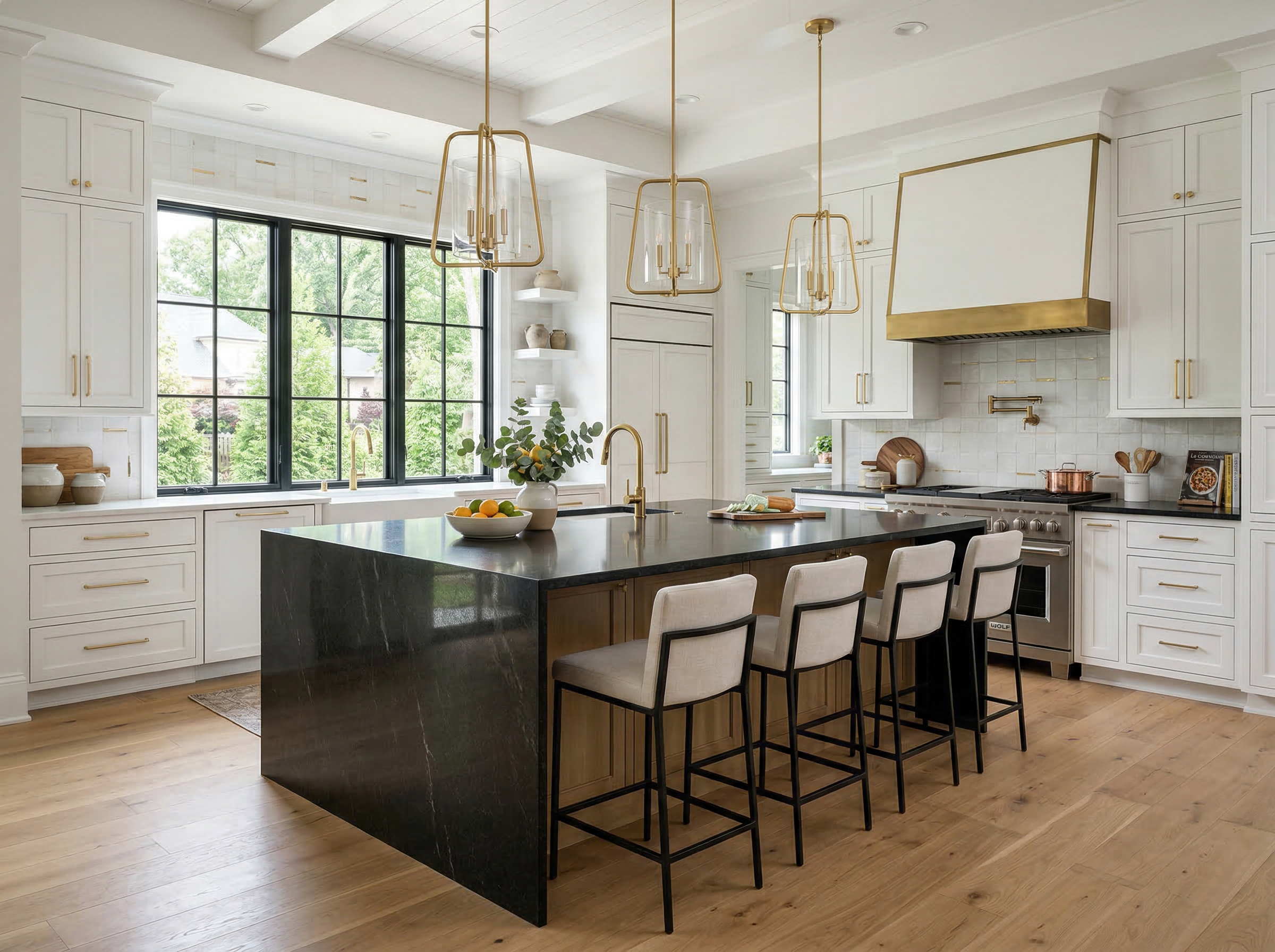
Granite isn't going anywhere, though. In fact, we're seeing a resurgence in darker granites for island accents — Steel Grey, Black Pearl, and Absolute Black are all moving well. The two-tone kitchen (white quartzite on perimeter counters, dark granite on the island) is one of the strongest design trends we're seeing in Charlotte right now. It gives you the best of both materials in one kitchen.
After fabricating thousands of countertops in Charlotte, we see the same mistakes over and over. Here's what to watch for:
Confusing quartzite with quartz. This is the number one mistake. Quartz is an engineered slab made from crushed stone and resin — it can't handle direct heat and has a uniform, manufactured look. Quartzite is a natural stone pulled from the earth. They sound similar, they sit near each other on supplier websites, and salespeople sometimes blur the line. Know which one you're actually buying. If you need a breakdown of how granite stacks up against engineered quartz specifically, read our granite vs. quartz comparison.
Not asking about sealing requirements for the specific slab. Not every quartzite seals the same. Some slabs are extremely dense and nearly non-porous. Others — particularly the softer, more translucent varieties — absorb liquids faster than you'd expect. A good fabricator will do a water test on your exact slab and tell you what to expect. If your fabricator can't answer this question, find a different fabricator.
Choosing based on photos instead of visiting in person. No photo — not even a good one — captures how a natural stone slab actually looks in your kitchen. Color temperature, vein direction, surface texture, how the stone interacts with your cabinet color and lighting — all of that disappears on a screen. We've had customers come in 100% set on a slab they saw online and leave with something completely different once they saw both options under real light. Always visit the slab yard. Always.
Ignoring your fabricator's experience with quartzite. Quartzite is harder than granite, which means it's harder to cut, harder to polish, and less forgiving of mistakes during fabrication. A shop that primarily works with softer stones may struggle with quartzite's density — you'll see rougher edges, less precise cutouts, and more risk of cracking during installation. Ask how many quartzite jobs your fabricator completes per month. At The Granite House, quartzite accounts for a significant portion of our weekly production, so our team and our tooling are set up for it.
Choose granite if you want a wide range of affordable options with proven durability and classic character. It's been the standard in Charlotte kitchens for decades, and for good reason — it performs, it looks great, and it fits most budgets. Choose quartzite if you want the look of marble with superior hardness and you're willing to invest more for a slab that makes a statement. Both materials are outstanding choices that will last the lifetime of your home.
The best way to decide is to see them side by side. Visit The Granite House in Charlotte, walk our slab yard, and run your hands across both materials. Feel the difference in texture. See how each stone catches the light. We'll give you an honest recommendation and a free estimate — no pressure, no games. Just two natural stones, straight talk, and the best fabrication in Charlotte.
The Granite House — Charlotte NC
Factory-direct granite, quartz, quartzite and marble. Fabricated in our Charlotte shop, installed by our team. One honest price.
Get a free, no-pressure estimate from Charlotte's factory-direct countertop team.
GET A FREE ESTIMATE →